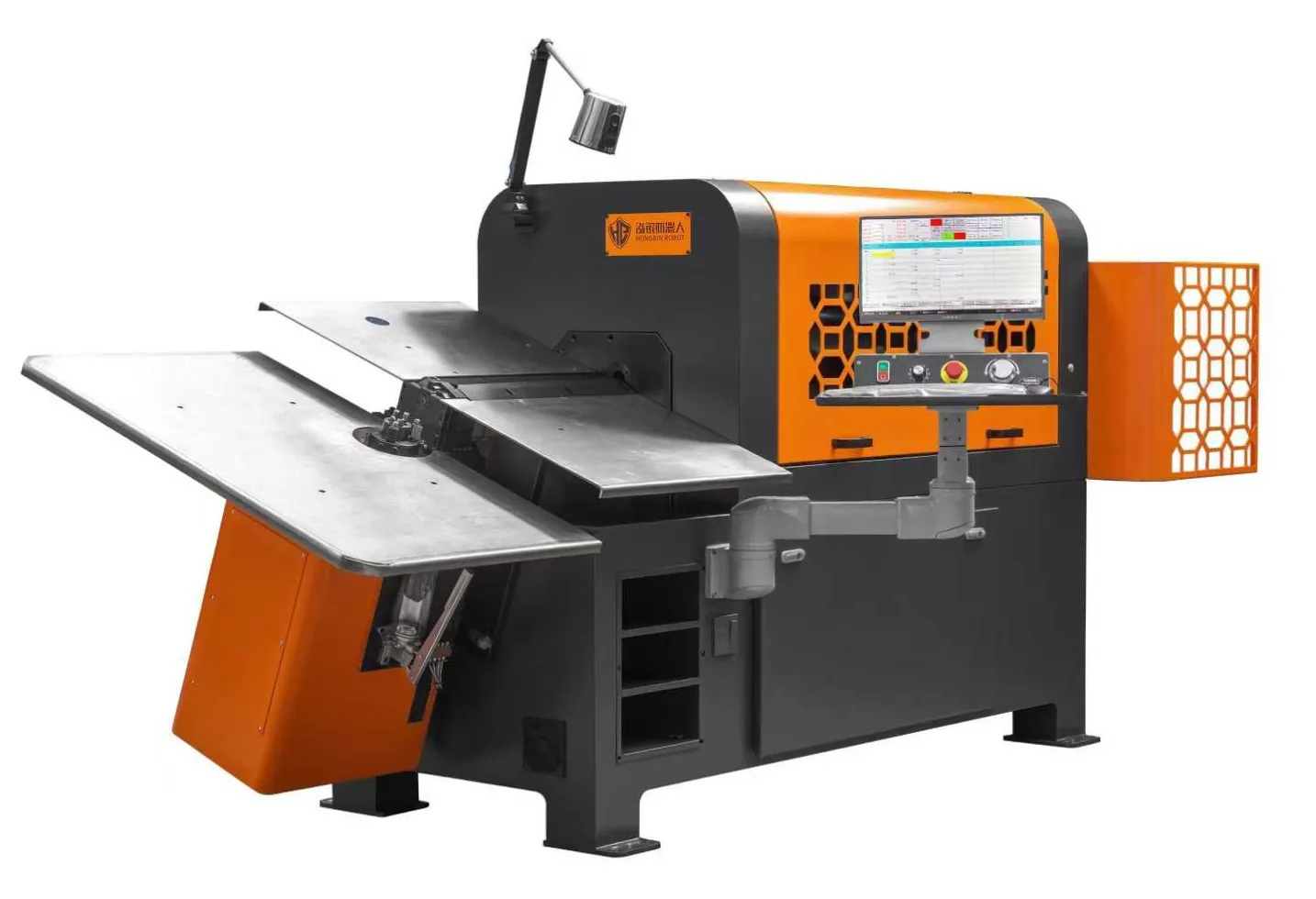
CNC Wire Forming Machine: How 3D Rotary Wire Machines Make Complex Parts
A CNC wire forming machine turns a drawing into a complex 3D wire part in one pass. See how 3D rotary wire machines work and what the HB-3D-560/660, HB-3D-760/860 and HB-3D-8100 can do.
A flat wire part is easy to picture. A three-dimensional wire part is harder: it bends in several directions at once, and every bend has to land in exactly the right place. That is the job of a CNC wire forming machine, and the 3D rotary wire machine is the type built for it.
In this guide we explain how a CNC wire forming machine works, how a 3D rotary wire machine forms complex parts in one pass, and what the three Hongbin 3D rotary models — the HB-3D-560/660, the HB-3D-760/860 and the HB-3D-8100 — can do. All of them form wire with a precision of ±0.1 mm.
What Is a CNC Wire Forming Machine?
CNC stands for computer numerical control. A CNC wire forming machine follows a program that defines every feed length, every rotation angle, every bend angle and every cut. The operator loads the wire and the program, and the machine makes the part. There is no manual measuring and no hand bending, so every part comes out the same. A CNC wire forming machine is a wire forming machine controlled by a computer, and a CNC wire bending machine is the same kind of machine: it feeds, turns, bends and cuts wire in one pass. For the basics, see our guide What Is a Wire Forming Machine?
CNC control matters most for complex parts. A simple flat part can be made on a simple machine, but a part with bends in several directions needs the program to coordinate feeding, rotation and bending at the same time. That coordination is what a CNC wire forming machine does, and it is what makes 3D rotary wire machines possible.
How a 3D Rotary Wire Machine Works: Feed, Rotate, Bend, Cut
A 3D rotary wire machine performs four steps in one pass. The rotary mechanism is the part that makes it three-dimensional.
Feeding. A servo feeder pushes wire from the coil into the machine at a programmed length. Hongbin uses imported high-speed servo motors and reducers, so feeding is fast and exact, and the machines run at a speed more than 25% above domestic peers.
Rotating. The rotary mechanism turns the wire around its own axis before each bend, so the next bend points in a new direction. This is the step that separates a 3D machine from a 2D machine: on a 2D machine the wire stays in one plane, while on a 3D rotary machine the wire can turn to any angle.
Bending and cutting. The bending head forms the wire to the programmed angle with a precision of ±0.1 mm, and a cutter cuts the finished part to length. Hongbin machines form 600-900 mm long material in one pass, so long parts are made in a single cycle.
The operator controls all of this from a computer interface that adjusts settings while the machine is producing, so changing to a new part is a matter of loading a new program, not rebuilding the machine. A wire butt splicer makes wire change easy and fast.
The Rotary Mechanism: Why 3D Parts Need Rotation
Imagine a wire part shaped like a three-dimensional frame: it bends left, then up, then back. Each change of direction needs the wire to rotate before the next bend. On a 3D rotary wire machine, a rotary mechanism turns the wire. On a rotary head machine, the bending head itself rotates. On a turntable machine, a turntable carries the wire through its rotations. The result is the same: bends in any direction, in one pass.
The number of axes tells you how many independent movements the machine controls. A 2D machine has 3-4 axes. A 3D rotary wire machine has 5-8 axes: the HB-3D-560/660 has 5-6 axes, the HB-3D-760/860 has 7-8 axes, the HB-3D-680/780/880 has 6-8 axes, and the flagship HB-3D-8100 has 8 axes. More axes mean the machine can form more complex shapes without a second setup.
Three Machines, Three Levels of Complexity
Hongbin builds four 3D rotary wire machines. Three of them cover the most common work, and the fourth extends the range to heavier wire. Browse the full range on the products page.
HB-3D-560/660. The HB-3D-560/660 3D Rotary Wire Machine is the entry point: 5-6 axes, hard wire of 2.0-4.5 mm and soft wire of 2.0-6.0 mm, a maximum unfolding length of 1000 mm and a precision of ±0.1 mm. It is the right choice for everyday complex 3D parts such as display frames, brackets and hooks.
HB-3D-760/860. The HB-3D-760/860 3D Rotary Wire Machine adds axes and size: 7-8 axes, the same 2.0-6.0 mm wire range, a maximum unfolding length of 1000 mm, and a larger frame for heavier work. Choose it when your parts are larger or more complex than the HB-3D-560/660 can handle in one pass.
HB-3D-8100. The HB-3D-8100 3D Rotary Wire Machine is the flagship: 8 axes, hard wire of 3.0-8.0 mm and soft wire of 3.0-10 mm, a maximum unfolding length of 1000 mm and a precision of ±0.1 mm. It is the largest model in the 3D rotary wire range, built for large, heavy three-dimensional wire parts.
HB-3D-680/780/880. The HB-3D-680/780/880 3D Rotary Wire Machine sits between them: 6-8 axes, hard wire of 3.0-6.0 mm and soft wire of 3.0-8.0 mm. If your wire is thicker than 6.0 mm, start here.
What Kind of Parts Can a 3D Rotary Wire Machine Make?
A 3D rotary wire machine makes parts that bend in more than one plane: three-dimensional frames, brackets, hooks, racks, display parts, supermarket shelves, furniture hardware, kitchen and bathroom storage parts, home appliance parts and auto components. If your part looks flat from one side but bends in another direction, it is a 3D part, and a rotary wire machine is the right tool. Flat parts belong on a 2D machine; see 2D vs 3D Wire Bending Machines: Which One Fits Your Parts? for the comparison.
The same machine can make many different parts. Changing parts means loading a new program, so a 3D rotary wire machine can run a display frame in the morning and an automotive wire part in the afternoon. That is why these machines are used in electronics, toys, home appliances, auto parts, kitchen and bathroom hardware, logistics and warehousing, and household hardware. To match your wire to the right machine, see How to Choose a Wire Bending Machine by Wire Diameter.
Precision, Speed and Long Material: What the Numbers Mean
Three numbers matter when you compare 3D rotary wire machines. Precision: Hongbin holds ±0.1 mm on every model, so bends land where the drawing says. Speed: Hongbin machines run at a speed more than 25% above domestic peers, because they use imported high-speed servo motors and reducers, imported bearings and gears. Long material: Hongbin machines form 600-900 mm long material in one pass, so long frames and racks are made in a single cycle.
Two more things matter. Warranty: every machine carries an 8760-hour (1-year) warranty. Service: after-sales response is within 24 hours in Guangdong and 48 hours outside Guangdong, and the computer interface adjusts settings while the machine is producing, so changeovers stay short.
Get a Quote from Hongbin Robot
If you have a complex 3D part, send us your drawing or a sample, your wire diameter and material, and your annual quantity. We will recommend the right 3D rotary wire machine and give you a quotation. Contact us through the Get a Quote page, or message us on WhatsApp. You can also write to cncwirebend@gmail.com or call +86-769-3366 9033.