What Is a Wire Forming Machine?
A wire forming machine feeds, turns, bends and cuts wire into complex 2D and 3D parts in one pass. Learn what it does, how it differs from wire bending, and which Hongbin model fits your parts.
Look around any home, shop or car and you will see wire parts: the frame of a display rack, the hook on a supermarket shelf, the bracket inside a home appliance, the spring in a piece of furniture hardware. Most of these parts start life as a plain coil of wire, and a wire forming machine is the machine that turns that coil into a finished part.
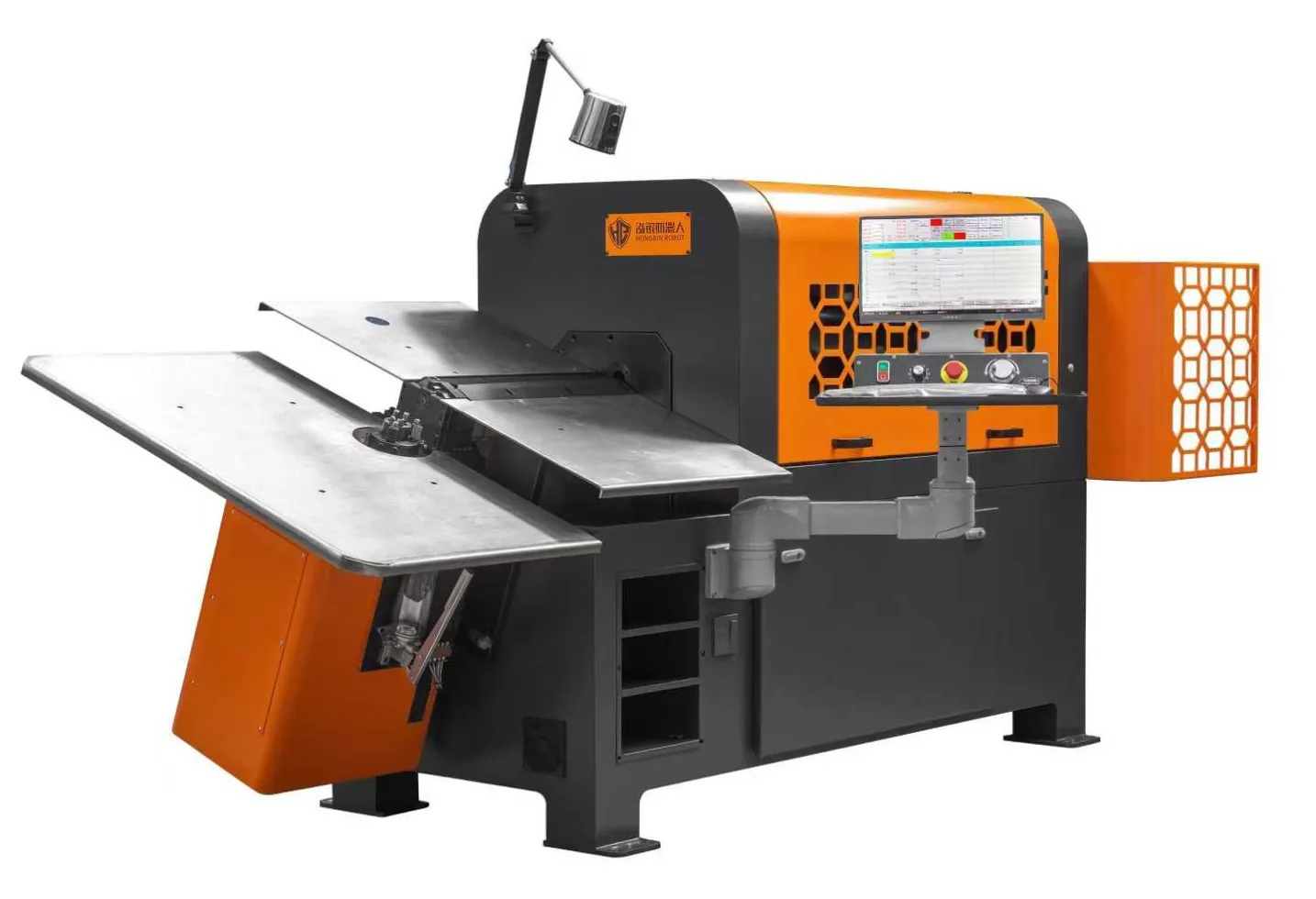
A wire forming machine is a CNC machine that feeds wire from a coil, turns it, bends it and cuts it to length, forming complex two-dimensional (2D) and three-dimensional (3D) parts in one pass. There is no manual bending, no second setup and no separate cutting step. The operator loads the wire, calls up a program, and the machine produces finished parts, one after another, at high speed and with a precision of ±0.1 mm.
Dongguan Hongbin Robot Co., Ltd. builds wire forming machines and wire bending machines for wire from 1.0 to 20.0 mm. This guide explains what a wire forming machine is, what it does, what it can make, and how it relates to a wire bending machine, with examples from the Hongbin range.
What Is a Wire Forming Machine?
A wire forming machine is a computer-controlled machine that shapes metal wire into finished parts. It works from a coil of wire, which can be steel wire, iron wire, copper wire or stainless steel wire. A feeder pushes the wire into the machine, a turning mechanism rotates the wire to the right angle, a bending head forms the bend, and a cutter cuts the finished part to length. Because all four actions happen in one machine and in one pass, a wire forming machine can produce parts that would take several manual steps, or several separate machines, to make by hand.
The key word is “forming”. Bending is only one part of the process. A wire forming machine controls the whole shape: the length of each straight section, the angle and radius of each bend, the direction of each turn, and the final cut. That is what allows it to make complex parts, for example a display rack frame that bends in several directions, or an automotive wire part with bends in three dimensions, in a single pass.
What Does a Wire Forming Machine Do? Four Steps in One Pass
Every wire forming machine, from a simple 2D machine to a 9-axis 3D turntable machine, performs the same four steps. Understanding them helps you judge what a machine can do.
1. Feeding. A servo-driven feeder pulls wire from the coil and pushes it into the machine at a controlled speed and length. Accurate feeding is what keeps every part the same length. Hongbin machines use imported high-speed servo motors and reducers for feeding, which is one reason they run at a speed more than 25% above domestic peers.
2. Turning. The wire is rotated around its own axis so that the next bend points in the right direction. On a 3D machine this turning is done by a rotary wire mechanism, a rotary head or a turntable. The HB-3D-940/960, for example, uses a 9-axis turntable. Turning is what makes three-dimensional parts possible: without it, every bend would lie in the same flat plane.
3. Bending. The bending head forms the wire to the programmed angle and radius, with a precision of ±0.1 mm. Several bends can follow one another in a single pass, so a part with many bends comes out finished.
4. Cutting. When the shape is complete, a cutter cuts the part from the wire, and the next part starts immediately. Hongbin machines can form 600-900 mm long material in one pass, so even long parts are made in a single cycle.
What Can a Wire Forming Machine Make?
A wire forming machine can make almost any part that can be drawn as a bent wire shape. Typical products include frames, brackets, hooks, racks, display parts, supermarket shelves, hangers and display racks, kitchen and bathroom storage parts, furniture hardware, home appliance parts, auto parts, stationery parts and industrial wire parts. Springs and special-shaped springs are also wire formed, and so are new-energy copper busbars, which are made on the HB-3D-940/960 turntable machine.
Wire Forming Machine vs Wire Bending Machine: How Are They Related?
If you search for these machines, you will see both terms, often for the same machine. The two terms overlap, but they are not exactly the same. Wire bending is one operation: bending wire to an angle. A wire bending machine is a machine that bends wire. Wire forming is the whole process: feeding, turning, bending and cutting wire into a finished part. A wire forming machine is a machine that performs the whole process. In other words, every wire forming machine is a wire bending machine in the broad sense, because it bends wire, but a simple wire bending machine that only bends, without feeding, turning and cutting, is not a complete wire forming machine.
In practice, most modern CNC machines do the whole process, so suppliers use the two terms for the same machines. Hongbin uses both: its 2D machines are called 2D wire bending machines, and its 3D machines are called 3D rotary wire machines, rotary head wire bending machines and 3D turntable machines. All of them feed, turn, bend and cut wire in one pass. When you compare machines, look at what the machine actually does, not only at its name.
For choosing a machine by wire size, see our guide How to Choose a Wire Bending Machine by Wire Diameter. For the difference between flat and spatial parts, see 2D vs 3D Wire Bending Machines: Which One Fits Your Parts?
2D or 3D? The Main Types of Wire Forming Machines
Hongbin’s wire forming machines fall into five groups. The right group depends on your part shape and your wire diameter. Browse the full range on the products page.
2D wire bending machines. The HB-2D-360/460 2D Wire Bending Machine and HB-2D-380/480 are 3-4 axis machines for flat parts. The HB-2D-360/460 forms hard wire of 2.0-4.5 mm and soft wire of 2.0-6.0 mm; the HB-2D-380/480 forms hard wire of 3.0-6.0 mm and soft wire of 3.0-8.0 mm. Both reach a maximum unfolding length of 1000 mm and a precision of ±0.1 mm. Choose a 2D machine when your parts are flat.
3D rotary wire machines. The HB-3D-560/660 3D Rotary Wire Machine (5-6 axes), HB-3D-760/860 (7-8 axes), HB-3D-680/780/880 (6-8 axes) and HB-3D-8100 (8 axes) form complex 3D parts in one pass. Wire diameters run from 2.0-6.0 mm on the smaller models to hard 3.0-8.0 mm and soft 3.0-10 mm on the flagship HB-3D-8100. Choose a rotary wire machine for complex three-dimensional parts in the 2.0-10 mm range.
3D rotary head machines. The HB-3D-560/660 Rotary Head, HB-3D-5120/6120 and HB-3D-6160/6200 rotate the bending head itself. They cover heavier wire: the HB-3D-5120/6120 forms hard wire of 6.0-9.0 mm and soft wire of 6.0-12.0 mm, and the HB-3D-6160/6200 forms hard wire up to 16.0 mm and soft wire up to 20.0 mm. Choose a rotary head machine for large, heavy 3D parts.
3D turntable machines. The HB-3D-940/960 3D Turntable Machine is a 9-axis turntable machine for fine wire: hard 1.0-2.5 mm and 1.0-4.5 mm, soft 1.0-4.0 mm and 1.0-6.0 mm. It is made for new-energy copper busbars and special-shaped springs, where precise, repeatable bends in fine wire matter most.
Spring machines. The HB-823 spring machine forms soft wire of 0.2-3.5 mm and steel wire of 0.2-2.3 mm into springs, and a chamfering machine deburrs the spring ends.
What to Look For When You Buy a Wire Forming Machine
When you compare wire forming machines, check five things. First, the wire diameter range: Hongbin covers 1.0-20.0 mm across the range, so match the machine to your wire, not the other way around. Second, precision: Hongbin machines hold ±0.1 mm. Third, the number of axes: more axes mean more complex parts in one pass, from 3-4 axes on 2D machines to 9 axes on the turntable machine. Fourth, long material: Hongbin machines form 600-900 mm long material in one pass. Fifth, speed and service: Hongbin machines run at a speed more than 25% above domestic peers, and every machine carries an 8760-hour (1-year) warranty.
Get a Quote from Hongbin Robot
If you are choosing a wire forming machine, send us your part drawing or a sample, your wire diameter and material, and your annual quantity. We will recommend the machine that fits your part and give you a quotation. Contact us through the Get a Quote page, or message us on WhatsApp. You can also write to cncwirebend@gmail.com or call +86-769-3366 9033.