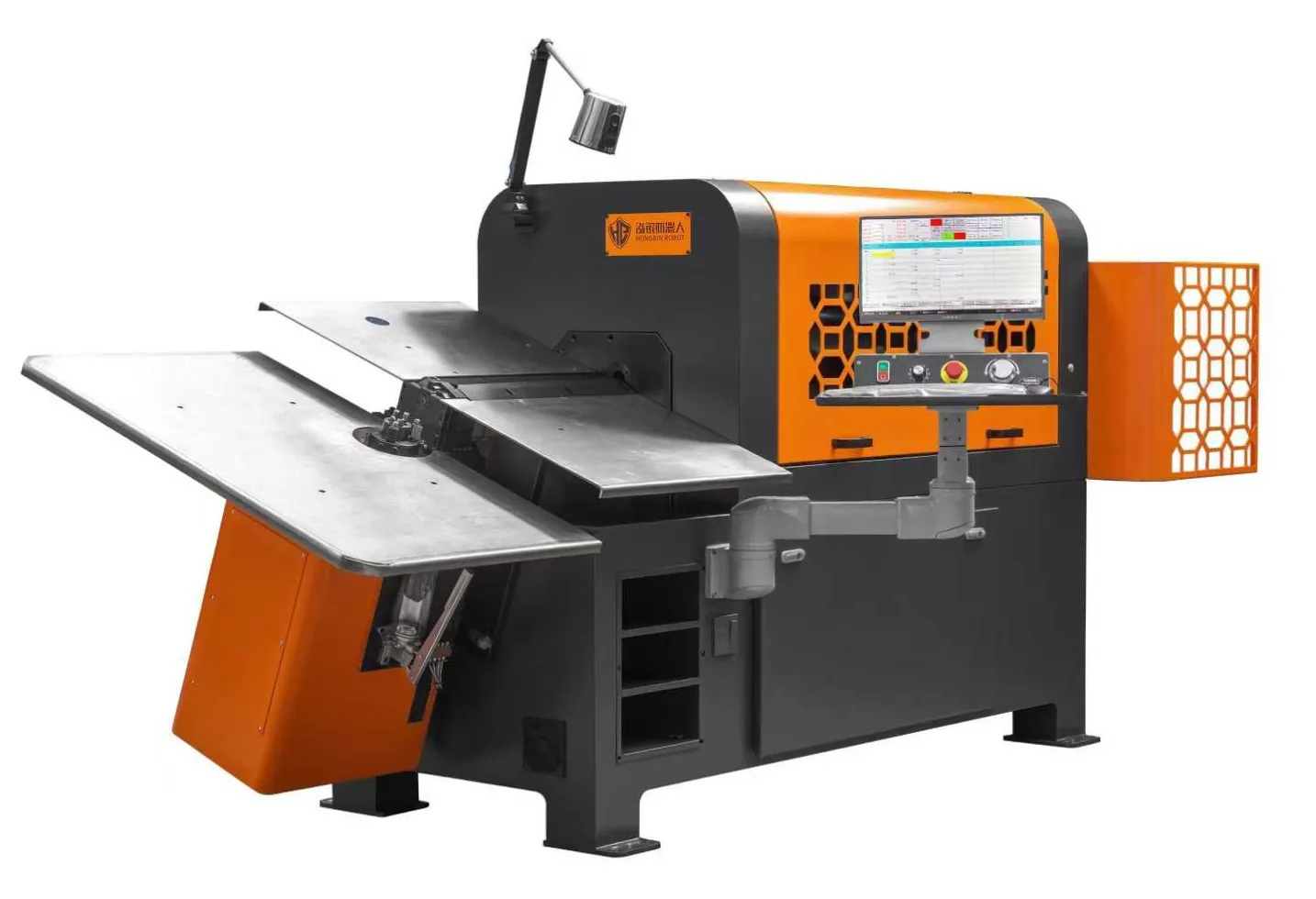
Wire Forming Machine vs Wire Bending Machine: What's the Difference?
Wire forming and wire bending sound alike, but they are not the same job. Learn what each term means, when to use each machine, and why Hongbin builds both, so you can choose by part, not by name.
If you are shopping for a machine to make wire parts, you will meet two terms again and again: wire forming machine and wire bending machine. They sound like two names for the same thing. They are not. They describe two different scopes of work, and choosing the wrong one can leave you with a machine that cannot make your part, or a machine that costs more than your part needs.
This guide explains what each term means, how the machines differ, and when to choose each one. The short answer: Hongbin builds both, so you can choose by your part, not by the name on the machine. The full range covers 1.0-20.0 mm wire with a precision of ±0.1 mm.
Two Terms, One Workshop: Why the Confusion?
Suppliers often use the two terms for the same machines, and that is part of the confusion. A modern CNC machine does the whole process — feeding, turning, bending and cutting — so sellers call it a wire forming machine one day and a wire bending machine the next. Buyers then compare prices between a machine that does one operation and a machine that does four, and wonder why the prices are different.
The words themselves give the answer. Bending is one operation: changing the direction of a wire. Forming is the whole job: taking a coil of wire and turning it into a finished part. Once you see that difference, the two machines fall into place.
What “Wire Bending” Means
A wire bending machine bends wire. That is its job: it takes a length of wire and bends it to an angle, one bend at a time, in a single plane. The classic example is the 2D wire bending machine, which forms flat parts — a display frame, a rack, a hook — from wire that stays in one plane. Hongbin’s 2D machines are the HB-2D-360/460 2D Wire Bending Machine (hard wire 2.0-4.5 mm, soft wire 2.0-6.0 mm) and the HB-2D-380/480 2D Wire Bending Machine (hard wire 3.0-6.0 mm, soft wire 3.0-8.0 mm), both with a maximum unfolding length of 1000 mm and a precision of ±0.1 mm.
Bending is simple, fast and economical, which is why 2D wire bending machines are the right choice for flat parts made in large volumes. If your part is flat and every bend is in the same plane, a wire bending machine is all you need. To match your wire to the right 2D machine, see How to Choose a Wire Bending Machine by Wire Diameter.
What “Wire Forming” Means
A wire forming machine forms wire. Forming is the whole process: feeding wire from the coil, turning it to a new direction, bending it to the programmed angle, and cutting the finished part — all in one pass. The result is a finished part, not just a bent wire. A wire forming machine is therefore a wire bending machine that also feeds, turns and cuts. For the full explanation, see our guide What Is a Wire Forming Machine?
Forming is what makes complex 3D parts possible. A part that bends left, then up, then back needs the wire to rotate between bends, and that rotation is part of forming, not part of bending. A CNC wire forming machine — a wire forming machine controlled by a computer program — coordinates feeding, rotation, bending and cutting at the same time. That is how a CNC wire forming machine makes complex 3D parts in one pass.
Side by Side: Wire Forming Machine vs Wire Bending Machine
The table below sums up the difference.
| Wire Bending Machine | Wire Forming Machine | |
|---|---|---|
| Meaning | Bends wire to an angle | Feeds, turns, bends and cuts wire into a finished part |
| Process | One operation: bending | Four steps in one pass: feed, rotate, bend, cut |
| Part shape | Flat, two-dimensional parts | Complex 2D and 3D parts |
| Axes | 3-4 axes | 5-9 axes |
| Typical machines | HB-2D-360/460, HB-2D-380/480 | HB-3D-560/660, HB-3D-760/860, HB-3D-8100, HB-3D-940/960 |
| Best for | Simple flat parts in large volumes | Complex parts in one pass, any direction |
Notice the overlap: every wire forming machine can bend wire, because bending is one step of forming. The reverse is not true. A simple wire bending machine cannot rotate the wire, so it cannot make a 3D part. That is why the two terms are not interchangeable — forming includes bending, but bending does not include forming.
When to Choose a Wire Bending Machine
Choose a wire bending machine when your parts are flat. If every bend is in the same plane and the part can be drawn as a flat outline, a 2D machine will make it faster and at a lower cost than a 3D machine. Flat display frames, racks, hooks, brackets and supermarket shelf parts are typical examples. See 2D vs 3D Wire Bending Machines: Which One Fits Your Parts? to check whether your part is flat or spatial.
The two Hongbin 2D models cover 2.0-8.0 mm wire. The HB-2D-360/460 handles hard wire of 2.0-4.5 mm and soft wire of 2.0-6.0 mm. The HB-2D-380/480 handles larger wire: hard wire of 3.0-6.0 mm and soft wire of 3.0-8.0 mm. Both machines form parts with a precision of ±0.1 mm and a maximum unfolding length of 1000 mm. Browse both models on the products page.
When to Choose a Wire Forming Machine
Choose a wire forming machine when your parts bend in more than one direction. If your part looks flat from one side but bends in another direction, it is a 3D part, and only a forming machine can make it in one pass. Three-dimensional frames, brackets, racks, furniture hardware, kitchen and bathroom storage parts, home appliance parts and auto components are typical examples.
Hongbin’s forming machines cover the whole range. The 3D rotary wire machines — the HB-3D-560/660 (5-6 axes, 2.0-6.0 mm), the HB-3D-760/860 (7-8 axes, 2.0-6.0 mm) and the HB-3D-8100 (8 axes, hard wire 3.0-8.0 mm, soft wire 3.0-10 mm) — handle most complex 3D work. The rotary head machines (HB-3D-5120/6120 and HB-3D-6160/6200) cover heavy wire up to 20.0 mm, and the 9-axis turntable machines (HB-3D-940/960) form new-energy copper busbars and special-shaped springs. All of them hold a precision of ±0.1 mm and form 600-900 mm long material in one pass.
Hongbin Builds Both: Choose by Part, Not by Name
Wire forming machine and wire bending machine are not rivals. They are two scopes of the same craft: bending is one step, forming is the whole job. A wire bending machine is the right tool for flat parts, and a wire forming machine is the right tool for complex 2D and 3D parts. Hongbin builds both, with a full range of 1.0-20.0 mm wire, a precision of ±0.1 mm, an 8760-hour (1-year) warranty, and a speed more than 25% above domestic peers.
Send us your drawing or a sample, your wire diameter and material, and your annual quantity. We will tell you honestly whether a wire bending machine or a wire forming machine fits your part, and give you a quotation. Contact us through the Get a Quote page, or message us on WhatsApp. You can also write to cncwirebend@gmail.com or call +86-769-3366 9033.